The No-BS Playbook: Eliminate 8 Marketing Time-Wasters Killing Your Team’s Productivity

Introduction – Why Marketing Teams Struggle with Time Waste
If you’ve ever wondered why your talented marketing team isn’t producing at the level you know they can, the problem usually isn’t skill — it’s friction.
Teams are drowning in unnecessary meetings, vague requests, and processes that belong in 2015. These “normal” routines look harmless on the surface but slowly sabotage momentum, morale, and revenue.
In high-performance environments, time is the scarcest and most valuable resource. Every hour wasted on inefficiency is an hour stolen from creative execution, campaign optimization, and revenue-generating work.
This isn’t about pushing people to work harder — it’s about helping them work smarter. And that starts by cutting the activities that create noise instead of results.
Here are the 8 marketing time-wasters you need to kill now, plus the systems that can replace them with speed, alignment, and clarity.
The Hidden Cost of Marketing Time-Wasters Activities
When inefficiencies stack up, the ripple effects are brutal:
Slower campaign launches mean competitors beat you to market.
Endless meetings drain focus before any real work begins.
Unmeasured content wastes production hours without proving ROI.
Redundant tools bloat budgets and confuse workflows.
Eliminating time-wasters isn’t just about freeing up calendars — it’s about unlocking exponential performance. A team running at 80% efficiency isn’t just 20% slower; it’s missing compounding gains in creativity, testing speed, and execution quality.
1. Campaign Planning Without Templates – The Chaos of “Blank Slate” Starts
Every time your team starts from scratch, you lose hours aligning on goals, timelines, and deliverables. Without a structured format, key steps get missed, deadlines slip, and no one can explain why.
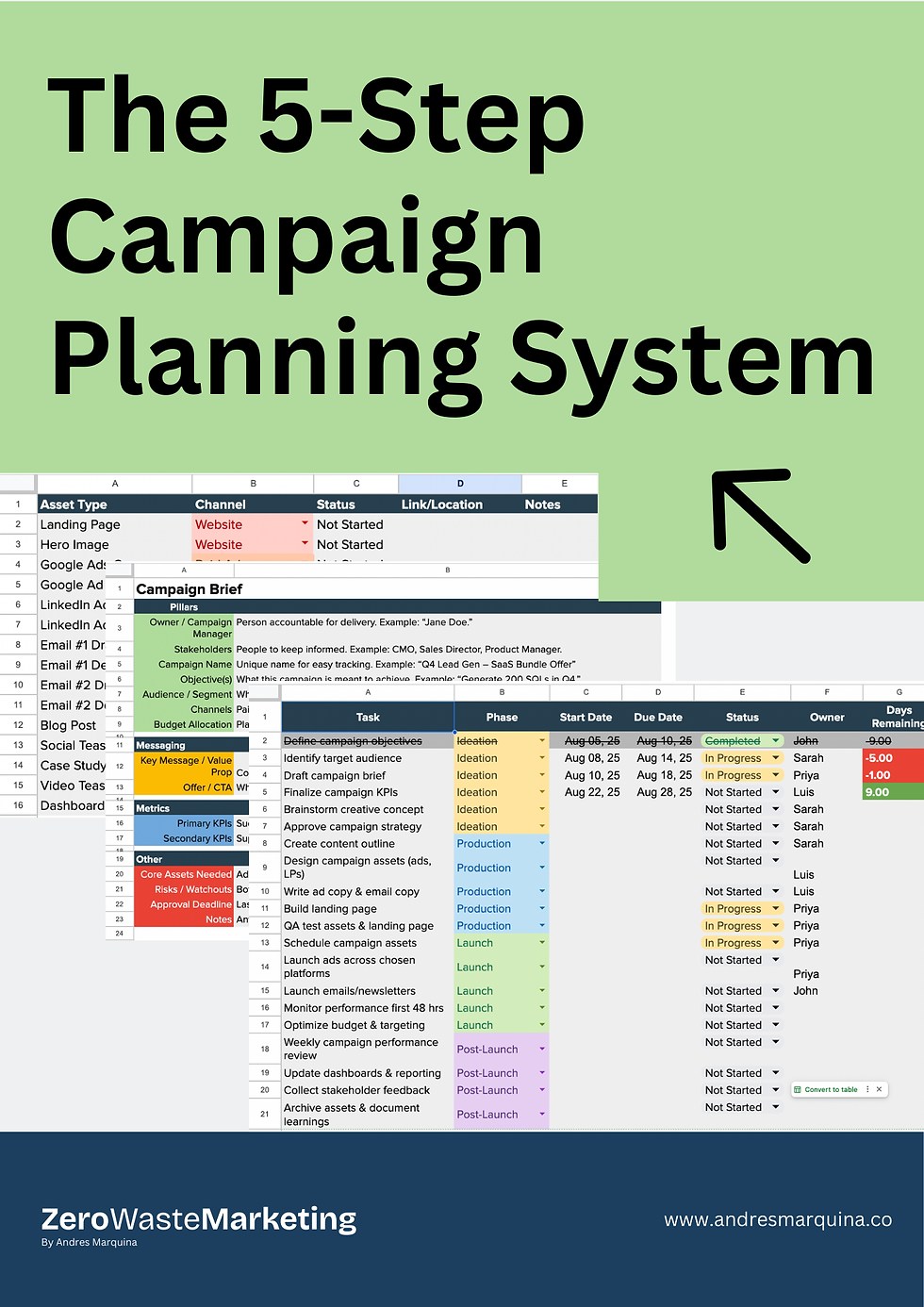
The Fix: The 5-Step Campaign Planning System
Campaign Brief Template: Clearly define objectives, audience, and KPIs.
Timeline Generator: Map every phase, from ideation to launch.
Asset Checklist: Ensure nothing is forgotten mid-production.
Roles & Responsibilities: Assign ownership from day one.
Feedback Loop: Pre-schedule reviews to prevent last-minute chaos.
This isn’t bureaucracy — it’s a blueprint for consistent, fast execution.
Download: The 5-Step Campaign Planning System
2. Daily Standups With No Actionable Outcomes – Meetings ≠ Momentum
If your daily standup doesn’t end with recorded blockers, decisions, or next steps, it’s just expensive small talk. Over time, these “mandatory” rituals erode energy and urgency.
The Fix: Action-First Standup System
Replace most standups with async check-ins. Team members share in a Slack or Notion channel:
Yesterday’s Progress
Today’s Focus
Any Blockers
Live meetings should be for true collaboration, not status updates.
Download: Action-First Standup System

3. Weekly Reporting in Slide Decks – Why Slides Are Time Traps
Hours go into polishing decks no one fully reads. Stakeholders glance, nod, and move on — without extracting real insights.
The Fix: Live Dashboards for Real-Time Access
Tools like Google Looker Studio, Tableau, or Power BI give everyone always-on visibility. Create stakeholder-specific views so leadership, campaign managers, and creatives see the metrics that matter to them — no slides required.

4. Overlapping Tools With No Clear Purpose – The Cost of a Confused Tech Stack
When every new challenge gets solved by buying another SaaS tool, you end up with duplicates, wasted spend, and team confusion.
The Fix: Tool Stack Inventory
Run a quarterly tech stack audit:
Define each tool’s primary purpose
Assign a primary user
Link it to an expected outcome
Anything without a clear owner or ROI goes.
Download: Tool Stack Inventory

5. “Urgent” Requests With No Brief – The Vague Request Vortex
“Can you make a quick ad?” turns into a week of revisions because no one clarified the goal, audience, or message.
The Fix: “No Brief, No Work” rule
Minimum info required:
Goal
Audience
Deadline
Key message or offer
This simple gatekeeping slashes last-minute chaos by up to 80%.
Download: “No Brief, No Work” Playbook

6. Campaign Approvals That Take a Week – Review Loops That Kill Progress
Five reviewers. Conflicting feedback. No deadlines. The campaign stalls in inbox purgatory.
The Fix: Streamlined Approval Blueprint
Limit reviewers to 2–3 people
Timebox feedback to 24–48 hours
Align expectations before the work begins
Approvals should enable quality, not slow it down.
7. Content That Isn’t Measured – If You Can’t Measure It, You Can’t Scale It
Publishing without tracking is like launching a product without checking if anyone bought it.
The Fix: Content Performance Report
Track performance with:
UTMs for every campaign asset
Engagement metrics like scroll depth, CTR, and shares
A content scorecard to compare pieces by ROI
Data beats gut feel every time.
Download: Content Performance Report Template

8. Guessing What’s Working – Hope Is Not a Strategy
Without proof, teams double down on the wrong tactics or abandon strategies that were working.
The Fix: The 3 Wins & 3 Fixes Ritual
Every week:
3 things that worked
3 things that didn’t
1 change to test next week
This keeps learning loops short and progress continuous.
Building a High-Performance Marketing Engine
The best marketing teams don’t outwork everyone — they out-system everyone.
By replacing outdated, inefficient habits with clear processes, you:
Launch campaigns faster
Reduce decision fatigue
Prevent burnout
Keep momentum consistent year-round
Perfection isn’t the goal. Repeatable excellence is.
Frequently Asked Questions
What are the most common time-wasting marketing activities?
Unstructured campaign planning, unnecessary meetings, redundant reporting, vague creative briefs, and long approval processes.
How can I identify inefficiencies in my marketing team?
Look for repeated delays, recurring complaints about unclear direction, or bottlenecks during handoffs. A time audit will reveal patterns.
Do modern teams still need daily standups?
Not always. If there are no blockers or decisions, async updates are often faster and more effective.
What tools replace weekly reports?
Live dashboards via Google Looker Studio, Tableau, or Power BI.
How can I fix slow campaign approvals?
Limit reviewers, set strict deadlines for feedback, and align on expectations before starting.
Conclusion – Cut the Waste, Keep the Momentum
Time is your marketing team’s most valuable asset — and wasting it is optional.
By cutting these eight productivity killers and replacing them with scalable systems, you create an environment where creativity flows, campaigns move faster, and results compound.
Your team doesn’t need more hours in the day. They need better systems in place. Start there, and watch your marketing engine run smoother — and faster — than ever before.


Comments